


|
|
|
|
|
|
|
|
Whenever I’m asked what a comedy writer’s job was like back when variety was king, people most often refer to the old Dick Van DykeShow where Rob, Buddy and Sally sat in an office trying to think up funny lines for their star, Alan Brady, to deliver. While writing jokes, sketches, song parodies and comedy routines did make up the bulk of our duties, the remainder was often devoted to heading off disasters of one kind or another. Comedy, like any activity performed in public for pay, is fraught with hidden dangers. London Derriere London, April 1979. It’s the day before we’re scheduled to tape an hour-long special, "An Evening at the Palladium," for a black-tie audience that will include Queen Elizabeth and Prince Philip. Gig Henry and I are going over the script with Hope in his dressing room, and, as usual when he was about to perform for royalty, he’s wrestling with some last-minute jitters. (“She has the keys to the Tower of London.” ) Also present are executive producers Sid Vinnage and Elliott Kozak, and a British writing team who had been hired to assist us, Dick Vosburgh and Gary Chambers. The phone rings. Hope picks it up, and on the other end of the line is one of our guest stars, Richard Burton, whose voice fills the room even though it’s not a speaker-phone. It seems that Dick’s “people” — read new wife of some three weeks, one of Burton’s “between Liz” marriages — don’t think it’s in the actor’s best interest to be doing a love scene with co-star Raquel Welch in a sketch we’d prepared for them — a parody of the popular PBS series "Upstairs, Downstairs" that we had re-titled "Backstairs at Buckingham Palace." Hope cups his hand over the mouthpiece and asks us if we can rewrite the sketch omitting the kissing. We all shake our heads “no” — if the love scenes go, there’s no sketch. Hope tells Burton he’ll get back to him and hangs up. We carefully go over the sketch line-by-line just to be sure, and Hope agrees that, unless Burton has lip privileges with the downstairs chambermaid, we’ll have to write a whole new sketch, and time, as they say over there, is frightfully short. Hope gets an idea. He calls Burton back and asks him if it would help if the chambermaid were someone other than Raquel. Several minutes elapse while Dick again checks with his people. That would solve the problem very nicely, he tells Hope. Goodbye, Raquel. Vinnage starts calling his British contacts and soon locates actress Susan George who’s appearing in a stage play about three hundred miles from London. Susan, an experienced performer who had recently costarred with Dustin Hoffman in the popular American movie, "Straw Dogs," agrees to step in for Raquel despite a case of laryngitis, finishes her matinee and arrives at the Palladium just hours before showtime. After a quick rehearsal, she bravely goes on for Raquel and ends up sharing equal-billing with Welch, Burton and Leslie Uggams. Later, Raquel explains to a group of British reporters that she had rejected the sketch because she was unhappy with her lines. This time, we were happy to take the rap. Vikings On Vicodin To be sure, unforeseen problems bedeviled every show to some degree, but by far themost ill-fated special Hope produced on my watch was taped at the Oscars Theater in Stockholm before Sweden’s King Carl Gustav and Queen Sylvia in February, 1986. Billed as a Command Performance, Hope had agreed to emcee the black-tie gala entitled Bob Hope’s Royal Command Performance from Sweden, the proceeds of which were to go to the king’s favorite charity, the Children’s International Summer Village. Hope would host the show and in return would own the American rights which he’d license to NBC. It was a potentially profitable deal since most of the production expenses would be picked up by the Swedish government. But even before the Scandinavian Airlines 747 had been loaded with our luggage at LAX, the hex kicked in. As fellow writer Gene Perret and I sat in the executive lounge putting the finishing touches on a Viking sketch we were confident would have the Swedes in hysterics from Goteborg to Lapland, producers Elliott Kozak and Dick Arlett came in and hit us between the eyes with the news that Sweden’s Prime Minister, Olaf Palme, had just been assassinated while walking his dog on a Stockholm street. Two other troubadours who would appear on the show, Shirley Jones and Emanuel Lewis, looked on in shock as transatlantic phone calls were hurriedly made to decide if the show would be canceled. A pall hung over the capital — literally and figuratively. Ships in the harbor stood at anchor, rigid and icebound — prisoners of a climate that almost half the year chills the bones and, one suspects, is no small contributor to the highest suicide rate in all of Scandinavia. But forget all that. The assembled glitterati applauded dutifully as the king and queen were escorted to the royal box. The show began with a rambling, largely incomprehensible introduction of Hope by Swedish actress Liv Ullman. It was obvious that she would have preferred being somewhere else, and who wouldn’t? Hope did his best to deliver his monologue, but had about as much luck getting laughs as an athiest at a Southern Baptist Convention. The evening’s slate of performers — Boy George and the Culture Club, Omar Sharif , Dolf Lundgren and Scott Grimes as well as Glen, Emanuel and Shirley — carried on like the pros they are, but the project was doomed from the start. It was like watching the lounge act on the Hindenburg. It was a wake with entertainment. We had written a sketch that cast Hope and Emmanuel Lewis, dressed in reindeer pelts and horned helmets, as a pair of Vikings on their annual spring plunder. As Gene Perret and I stood offstage, puzzled why our pillage jokes were drawing gasps, one of the Swedish technicians pointed out that we had named Hope’s character, Olaf. In the confusion, no one had caught what now appeared to be an insensitive joke. During a break, we told Hope what had happened and he immediately called a halt to the proceedings and apologized to the audience. When our Swedish fiasco finally concluded and we were winging home to a much warmer Los Angeles, I remember thinking back — I should have known from the start that the trip would turn out to be jinxed. Excited over my first junket to a Scandinavian country, I arrived at LAX sans passport! A messenger from the Hope office was dispatched to deliver it, but to avoid a delayed departure, a representative from the airline soon arrived and announced that my California drivers license would do the trick! My passport would follow on the next flight — without me. I learned later that Sweden had waived their usual customs requirements because I was on a special assignment for the king! Proving once again that it pays to work for someone who’s close to kings. Seashell Shocked The season following the debacle in Stockholm, it was decided we should get right back on the horse before we lost our nerve. And what more relaxing locale in which to regain our confidence than lush, tropical Tahiti? Well, it sounded good on paper, anyway. Once again, our co-producers were Elliott Kozak and Dick Arlett — could these guys have been carrying around a voodoo curse? They had arranged what appeared to be a mutually beneficial promotional arrangement with America-Hawaii Cruises. The hour-long special would include guest stars John Denver, Howard Keel, Jonathan Winters, Morgan Brittany, and the reigning Miss America, Susan Aiken. It would be taped in and around Moorea and the island chain’s capital, Papeete. Hope would perform an eight-minute monologue from the promenade deck of the cruise ship S.S. Liberte that was docked in Cook’s Bay. We were in a tropical paradise known the world over for its crystal clear lagoons and azure blue beaches crawling with topless, grass-skirted beauties renowned for their warmth, charm and indigenous friendliness. What could possibly go wrong? Well for starters, Hope, introduced from off-deck, strode out in a straw hat and multicolored Hawaiian shirt and began his monologue with this line: "Here we are aboard the S.S. Liberte on the island of Moorea. The audience, huddled together on deck chairs, stared back at Hope like they’d just been struck by an iceberg. If this bunch had ever done any swinging, it was during the Roaring Twenties. And the roar was down to a whisper. We had written a monologue for the "Love Boat," and it was being delivered on the S.S. Geriatric. In our rush to get aboard and set up, no one had bothered to check the passenger manifest, and now the vessel was scheduled to depart within hours. It was too late to regroup, so Hope had no choice but to press on, hoping we could edit in some canned laughter back home. "This is the Liberte which means freedom in French, and Again, the audience hasn’t a clue as to what he’s talking about. If they had done any cabin hopping the night before, it was to borrow a cup of Metamucil from a neighbor. As Gene and I stood at the railing seriously considering a swan dive, Hope glanced over at us with a look that said, “I should have become an accountant.” But Gene, ever cheerful, mouthed the words, “Keep going. You’re doing great.” Hope did, but he wasn’t. "One guy’s been so busy at night, he couldn’t remember where his Right about now, Hope looks like he’d prefer to be on another one, too. "One gal asked the captain to perform a marriage ceremony At last, a huge round of applause from a group of couples celebrating fiftieth wedding anniversaries. After a few more jokes, the bellman announces that it’s time for another buffet, the audience files out en mass, and we hold an impromptu burial-at-sea for the monologue. We had learned the hard way that Hope’s on-deck performances worked best with audiences in uniform. Several months later, the cruise line declared bankruptcy, and the Liberte was sold at auction, refitted, repainted and renamed. We never found out if we had contributed to its demise. First it had been a dead prime minister, then a bankrupt cruise line. Back in 1984, the World’s Fair in New Orleans had gone bust right after we taped a two-hour special there to promote it. Watch for a special on the Sci Fi Channel entitled "The Unexplained Curse of the Bob Hope Show." Adventures in Paradise Things began to look up when we settled into our assigned accommodations on Moorea — thatched-huts tucked among the volcanic ash and pearl-white sand of a beach that a few decades earlier had made Gauguin relocate. Each suite had its own waterfall/shower carved from coral, and at high-season rates of four-hundred dollars a day — a substantial sum for lodging back then — they were a cut above Holiday Inn. The hotel-on-the-beach was the brainchild of three Americans — classmates at U.S.C. — who had visited Tahiti during spring break one year and decided it would be an ideal location to erect a getaway for the rich, near-rich and people who wanted to be pampered in a spot that’s so remote, it had taken four days for news of NASA’s recent Challenger disaster to reach the islands. The current owner had bought out his partners, taken a Tahitian wife, produced a bunch of kids and confided to me that he didn’t mind not getting news from the outside world for weeks on end. You can check out his photo in the dictionary under “laid back.” One day, while at our duty station at the open-air bar, we heard our assistant director knocking on John’s door. “Half hour, John. We’re almost set up.” Mr. Rocky Mountain High was scheduled to tape a song while combing the beach nearby. The assistant left but soon was back. Knock, knock, knock. “Fifteen minutes, John.” Still no John. Ten minutes later, he reappeared, carefully threading the walkway for the third time. Knock, knock, knock. “Five minutes, John.” He pressed his ear against the bamboo door. Nothing. He shook his head and waved toward an assistant on the beach. “The hell with it. Set up Morgan Brittany’s number!” Captian Blight Each morning, Gene and I worked while trying not to notice the beach where halter tops appeared to be illegal. But we did manage to put the finishing touches on comedy bits for Jonathan as an American tourist, a Tahitian politician and a French chef as well as our Mutiny on the Bounty sketch. Along with our colleagues who were holding down the fort back home, we had been hammering away at thescript for several weeks. The plan was to tape the sketch aboard an exact replica of the legendary schooner that had been built by director Dino de Laurentis for his movie version of the epic tale. Actually, it was the Bounty from the waterline up and a luxurious yacht below with plush lounges, guest compartments, a huge kitchen and a spa. The Bounty which was anchored in a lagoon on the opposite side of the island. Our richly costumed period sketch would feature Hope as the cruel, crew-beating Captain Bligh; Howard as the ship’s doctor; Susan Aiken as his nurse; Morgan Fairchild as the prim, school marm passenger; John Denver as the young, Wahini-smitten Fletcher Christian and Jonathan Winters as his tribal chief, soon-to-be father-in-law. Even under ideal studio conditions, accommodating such a large cast on the small screen is a tall order for any director, and Walter, one of the best, had his hands full with this one. While the ship had been ideal for de Laurentis who had the time to set up multiple camera shots, it was soon apparent that it wasn’t big enough to do our sketch on. People were a lot smaller in the eighteenth century, and everything was about three quarter scale. In many of the scenes, members of the cast were sardined on her decks tighter than Cuban boat people. They looked like they were performing in a telephone booth. So much for exact replicas. Walter tried setup after setup, attempting to create the illusion of size and depth. As a result, the taping ran longer than scheduled, and the entire company was supposed to depart that evening. A few crew members were sent back to our hotel-on-stilts to pack for those who had to remain to get the sketch, such as it was, in the can. Finally, at about four in the afternoon, Walter yelled “Cut! That’s a wrap!” The cameras, lighting and sound paraphernalia were stowed into dockside trucks in record time. Electronic equipment hadn’t disappeared that fast since the L.A. riots. Everyone raced to the waiting busses which would convey us to the harbor where the swiftest picket boat on the island was standing by. A smiling Quantas representative assured him that the plane would arrive in the morning as promised. We were given our hotel assignments — a Bar Exam Sometimes, problems didn’t arise until after a show had been taped which made them even more troublesome and costly. One year, we did a Halloween special on which one of the guests was Cassandra Peterson, well-known as a Charles Addams-like character named Elvira. She appeared in a parody of the popular sitcom "Cheers" asa customer in the bar opposite Hope as the show’s bartender, Coach. In our sketch, Cassandra entered the bar, looked Hope up and down, and said, “Nice job. Who’s your undertaker?” The Halloween special was scheduled to air on Sunday night but on Friday, Nick Callesandro, the actor who played “Coach” on Cheers, suffered a sudden heart attack at his home in Burbank and died. Minutes after the grim news was broadcast, my phone rang. It wasHope with instructions to call the writers and have them begin working on a replacement line that could be dubbed onto the master tape, which had already been delivered to the network. In the meantime, hesaid, he would notify Cassandra to meet us at the sound studio for the emergency-looping session. The line we were to come up with not only had to make sense in the context of the sketch, but it also had to match as closely as possible the actress’s lip movements. We tried five or six replacements until everyone settled on “Nice job. Did your makeup man quit?” The syllables matched perfectly and even on a large studio monitor, it was difficult to tell that her voice had been dubbed. It was only a small change, but Hope had gone to the trouble and expense of fixing the line, knowing that failure to do so might make himappear crass and unfeeling to a television audience unaware that segments of so-called “live” shows are often taped well-in-advance. When it came to protecting his image in the eyes of the public, Hope’s judgment was usually sound. Usually. Hudson Hornet’s Nest Hope enjoyed trading the latest raunchy stories going around with a telephone network of cronies that at one time had included Ronald Reagan, Tip O’Neill, Dan Rostenkowski, Gen. Westmoreland, Stuart Symington, and, for a brief time in the early sixties, J.F.K. He loved a good joke from whatever source, but whenever he veered very far afield from his prepared material, the consequences could be disastrous. On the vessel that night was the A-list of New York society led by Governor Hugh Carey. During the cocktail-reception preceding dinner, Hope visited the men’s room where another guest, docked at an adjoining urinal, told him a joke he’d just heard. That happens often to comedians and comedy writers — “Hey, I thought you could use this!” Both men laughed heartily, and Hope decided that the line might, indeed, be a welcome addition to So, several minutes into his routine, he casually dropped in a joke that would reverberate for months and let loose something Hope was unaccustomed to — an avalanche of adverse publicity. He said: “Hey, have you heard? The Statue of Liberty has AIDS. Nobody knows if she got it from the mouth of the Hudson or the Staten The following morning, a reporter for the New York Post led off with the gaff in his coverage of the event, and the worms, as they say, exited the can. Ward Grant, Hope’s faithful spinmeister quickly drafted a press release explaining that the line had been misinterpreted, taken out-ofcontext, or some such excuse PR men must come up with whenever a client finds himself with a mouthful of foot. But the incident would require more than the standard damage control. Gay and lesbian groups Ironically, the incident recalled the bad press that resulted back in 1971 when Hope was quoted in a Life Magazine cover story as having said: “The Vietnam War is a beautiful thing — we paid in a lot of gorgeous American lives, but we’re not sorry for it.” Throughout his career, Hope avoided making many mistakes that would draw the public’s ire, but whenever he did, they were lulus. He had learned the hard way that, as advancing age was putting him more and more out of touch with the sensitivities of his audience, he’d best stick to the script. He realized, wisely, that his days of ad-libbing a joke that hadn’t been written for him were long past.
This excerpt may be reproduced without changes if properly credited.
|
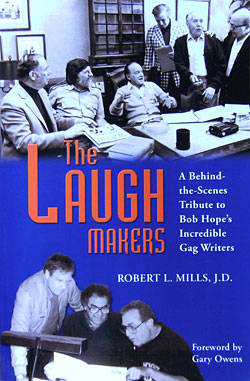
Excerpted from "THE LAUGH MAKERS: A Behind-the-Scenes Tribute to Bob Hope's Incredible Gag Writers"
LOOK FOR IT HERE!
TV
Blog / Classic TV Blog / 2009
TV Shows / Classic
TV / I
Love Lucy / Television Shows / TV
on DVD / TV
Shows on DVD / Prime
Time TV / Television
Blog/ TV Show
Reviews / TV
Shows on DVD Reviews / TV
DVD Reviews
DC
Comics on DVD
Hit Shows of the Seventies: Hitchhiker's Guide to the Galaxy / Gene Roddenberry in the 1970s / Star Trek Animated / Fall Previews of the 70s / Lance Link, Secret Chimp / Star Wars Holiday Special / Alias Smith and Jones / 1977 Year in Review / Top Ten 1970-76 / The Rockford Files / All in the Family / Sam Hall (Dark Shadows) Interview / Battlestar Galactica / Wonder Woman / Network Jingles / Class of '74 / Happy Days / Good Times / Mr. Bill / Dinah! / Maude / Doris Day Show / Pamelyn Ferdin Interview / The Bicentennial Minute / Jingles & Catch Phrases of the 1970s / Early Cable TV 1970s / TV commercials for Women / TV Moms / Bette Midler in the 1970s
|
 |
 |
Man From UNCLE now on DVD! |
|
 |
|
 |
 |
 |
  |
||||
 |
 |
|||||
|
|
||||||||||
| |
Back
to the menu Contact Us / Survey Other Cool TV Sites TVparty! Television Blog |