







|
|
|
|
|
|
|
|
|
|
||||
|
|
|
||||
|
|
Great comic books of the Sixties As a kid, I first discovered comic books in 1965 when
I saw the tag at the end of the Superman TV show that was then in re-runs.
It stated that Superman was a character that appeared in Action Comics
and Superman Magazines, so I had to have some.
After my father took me to get my (seems like) weekly
haircut, I begged him to get me a 'Superman Magazine,' he took me across
the street to a drug store and bought me a 25 cent Superman Annual. After
I read it cover to cover, several timesa, I mailed a dollar off to National
Comics for a year's subscription to Superman comics even though my parents
warned me that I wouldn't get anything, that my dollar would disappear
forever and that it would be a disillusioning experience for me. It was.
For all of 1965, I was treated to some great Superman
comic books delivered monthly by the US mails, and I had my first inkling
that my parents might be full of shit.
Featured here are some examples of the best the comic
book industry had to offer in the 1960s - one thing these comics all have
in common is that they were all short runs. For some reason, good quality
television shows and comic books rarely lasted very long in the sixties.
The books shown here are examples of excellent comics
that are still entertaining to read today. A study of some of the best
Marvel comic books of the sixties is coming but someone else will have
to do that, I preferred the simple and less serious approach to storytelling
that DC took to the angst ridden Marvel heroes of the time. |
|

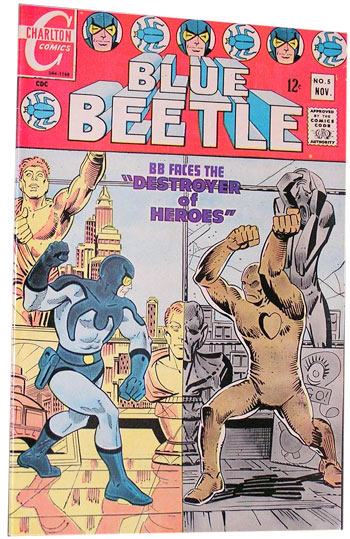
| Blue Beetle no. 5 © DC Comics When Steve Ditko left Marvel after co-creating Spiderman
and Doctor Strange, he went to lowly Charlton Comics to resurrect slack
superheroes Captain Atom and The Blue Beetle.
Poorly paid but freed creatively, Ditko did some of the best work of
his long career here, bringing to life many fascinating characters in
intriguing situations (just as he did for Marvel) but sales were low and
distribution spotty for these Charlton books.
Blue Beetle number 5 may be the finest comic book Charlton ever published
in it's thirty-some year history, an era that contains very few quality
books scattered among a sea of mediocrity, all plagued by lousy production
values and stone age printing.
Blue Beetle number 5 was published during a spurt of quality comics that
came in the two years when Dick Giordano was editor at Charlton and this
was Steve Ditko at his peak. Look for the odd abstract statues and paintings
in the panel backgrounds, they are works of art in themselves.
This release also includes the bizarre, Ditkosophical backup feature,
The Question. The last issue of a fantastic run of comics. |
|
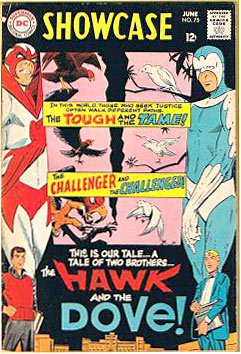 |
Showcase no. 75 © DC Comics june 1968 Shortly after, Steve Ditko took his act to DC for two fine
creations, The Creeper and The Hawk And The Dove. He only completed three
issues of The Hawk and the Dove before falling ill; the title was continued
by Gil Kane until its cancellation with number 7.
Sadly, Ditko stopped producing much work of any real interest in mainstream
comics for a while after this point, though he occasionally works in the
industry to this day. This comic book is unadulterated Steve Ditko, a
great script with a hint of Ditko's infamous ultra-conservative moralizing.
Steve Ditko concentrated on the alternative press in the seventies (the
preachy but entertaining Mr. A) and continued to create a few new characters
and concepts for mainstream comics (Shade, the Changing Man for DC was
a stand-out) well into the eighties. |
|
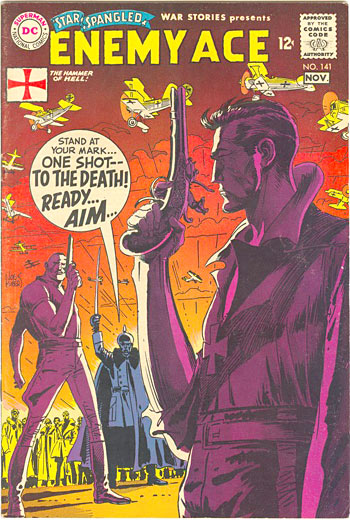
Star Spangled War Stories no. 141 Enemy Ace was one of the best written and drawn series of commercial comic books ever published. Written by Robert Kanigher and drawn by Joe Kubert (Sgt. Rock) at the top of their game, Enemy Ace's 12 issue run was largely ignored, even by many old school comic book fans. Kubert's raw style set the standard for war comics for decades, and this saga of a World War One German fighter ace with a conscience is drawn with an eye for detail and historical accuracy. The sympathetic-to-the-Nazis approach in war comics didn't last very long despite the great storytelling contained here. |
 |
| |
The Spectre
no. 1 State of the times DC scripting by veteran Gardner Fox made fantastic by Murphy Anderson's detailed and deliberate artwork. Anderson's art is in a class of its own, he is undoubtedly one of the finest illustrators in the history of comics and one damn fine inker. This comic book had a short ten issue run, Anderson only drew this one issue by himself. This short run includes great stories written and drawn by Neal Adams, a strange Grandenetti/Anderson collaboration and one of Berni Wrightson's first published works when the book switched to a generic mystery format for the last two issues. |
|
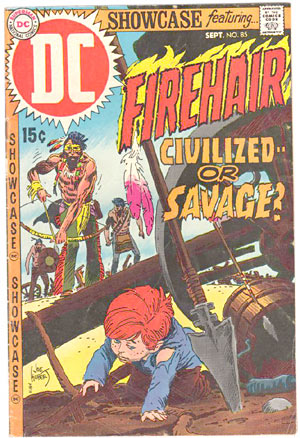
Showcase 85 Written and drawn by Joe Kubert, this work was obviously more personal to the artist, it's his 1960's mainstream masterpiece. The saga of Firehair, a settler's child raised by Native Americans who is spurned by whites as he grows older, lasted only three issues in Showcase and a few short stories in the back of a comic book called Son of Tomahawk. All of the Firehair stories are superior examples of the best comic book tales the industry could offer, then or now. Kubert does a great job of capturing the feel of the old west, the look here has an authentic, southwestern flavor, the characters are more complex than kids were used to in the publications from DC in 1969. |
 |
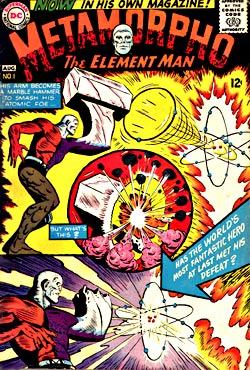 |
Metamorpho no.1 © DC Comics aug 1965 Only the first four issues of this short run of comic books contain the great art of Ramona Fradon. From that point on, it was a good imitation of Fradon's fluid, gooey style, but the freshness and spontaneity that she brought to those stories, and to the preceding Brave and Bold tryouts, was mostly gone. Fradon is an under appreciated female comic book artist - a rarity in a Field dominated by men at this time - and her Metamorpho comics are real gems thanks in part to superior inking by the great Charles Paris. There was still a bouncy liveliness to the storytelling in the later Metamorpho issues, with several drawn by Joe Orlando and inked by Paris. The stories by Bob Haney are sparkling adventures that race frantically from one exotic locale to another. |
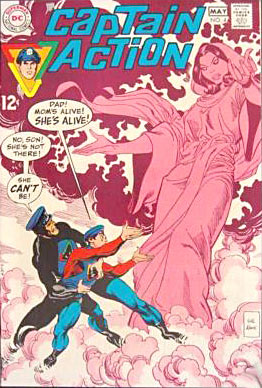
| Captain Action no. 4 © DC Comics may. 1968 Based on the Ideal brand toy of the same name, this
book only ran five issues, but what a run.
Artist Gil Kane passed away recently, and this run of comics contains
some of his most effective mainstream work. He wrote and drew issues
3-5, with superb inking by Wally Wood. (Jim Shooter wrote the first
two issues while Wally Wood penciled and inked the first issue).
Two of DC's best short run series were based on toys - Hot Wheels
and Captain Action. Both had great art and story teams but neither
books were successful for some reason.
I had to wonder at the time if this was supposed to be the same Captain
Action that was portrayed in the toy commercials, after all he
could turn into Spiderman and Captain America - those characters were
published by Marvel. It is to Gil Kane and editor Julie Schwartz'
credit that they turned this comic into something very special. |
 |
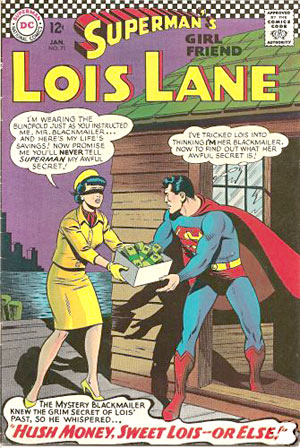 |
Lois Lane no. 71
© DC Comics jan 1968 Kurt Shaffenberger
was one of the slickest artist in DC's bullpen and the 'Lois Lane' comics
of the sixties were a lot of fun to read mostly because of his unique
renderings of the DC stable of characters.
It's sheer silliness as each issue Lois Lane tries to rope Superman
into marriage by making him jealous or by taking some potion that turns
her into a monster or super-herione.
These comic books are ice cream for the brain, much of the reason
they are so much fun has to do with Shaffenberger's pristine style and
the light-hearted, nonsensical stories. |
|
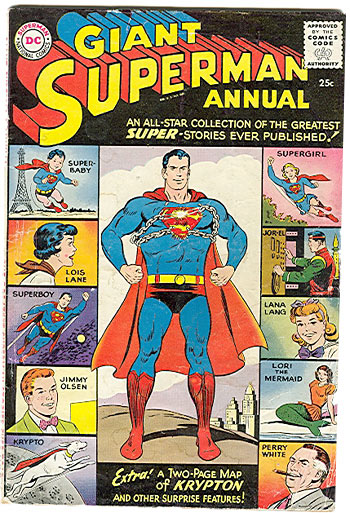
Superman Annual no. 1 Maybe the most famous and parodied comic book cover ever. This is the first reprint annual for a super-hero comic book and it presented many of the seminal Superman stories of the fifties. The cover (by the late Curt Swan) has a crisp, modern design that must have looked very handsome on the newsstands of the day. The stories include those old saws like the giant ape with the Kryptonite vision and the story of Lex Luthor losing his hair and the origin of the chunky Superman of the fifties. |
 |
 |
Our Army at War
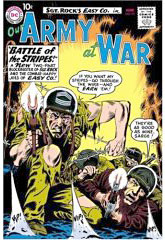
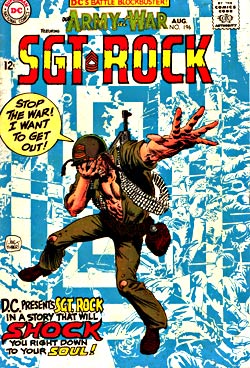
no. 196 © DC Comics aug 1968 DC's war books all had great covers by Joe Kubert, every one telling a multi-layered story, mostly with the Nazi's hiding just beyond the American soldier's view. This issue has one of those familiar, formulaic stories written by Robert Kanigher and illustrated by Joe Kubert that made this comic book series so popular in it's heyday. Almost every Sgt. Rock story had a theme it seems, and Kanigher would repeat and repeat the theme throughout the story. This issue deals with war through the ages, and introduces The Unknown Soldier. There are some real gems hidden in 'Our Army at War's long run, with stories in the back of the books by the best illustrators working in comics, people like Wally Wood, Reed Crandall, Russ Heath and Alex Toth. In the mid-seventies, editor Kubert ended each Sgt. Rock story with the slogan "Make War No More", now they make Sgt. Rock no more. |
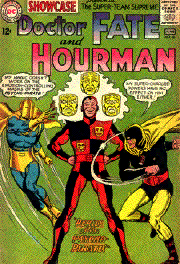
| Showcase no 56 Another great 'Showcase' comic, and there were a lot of them. If you have a collection of 'Showcase' and 'Brave and the Bold' comics, you have some of the best examples of DC comic books in the sixties. Murphy Anderson and Gardner Fox revive two of the golden age's most popular comic characters here with excellent results. While the characters didn't catch on a second time, the art and story rank with the best. |
 |
 |
Bat
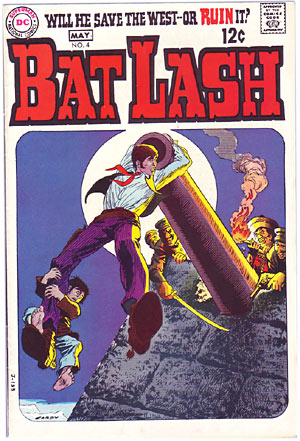
Lash no. 4 © DC Comics may 1969 Bat Lash held on for seven whole issues after his Showcase tryout. Brilliantly written by Sergio Aragones (of Mad magazine fame) with Denny O'Neil and drawn broadly by Nick Cardy (in his best, most expressive period). This is a genuinely funny comic book, Aragones' characters ring true and Cardy does a superb job of bringing these characters and the wild western setting to life. |
|
 |
 |
|
|
 |
|
| DC
Comics on DVD here! |
Superman
on DVD Batman on DVD |
The
Flash on DVD Super Friends DVD |
Superman
Doomsday Smallville on DVD |
||
|
|||||||||||||||||
 |