 |
 |
 |
 |
|
 |
 |
 |
|
|||||||
TV
Shows on DVD/ / /
/ / / / /
/ / / / / / North Carolina Actors /
/ / / / / / Cartoons
on DVD/ / / / / /
/ Holiday
Specials on DVD /
/ / / / / /
/ / / / / /Classic
Commercials / / / / / TV
Shows on DVD Reviews |
|||||||
|
Oddball 1950's TV Game Shows
PR4 & PR5 Pages for ads - CHEAP!
TV
on DVD / /Holiday
Specials on DVD
Christmas
& Holiday specials |
At
various times in television history, game shows have been popular daytime
AND prime-time fare. Here's a review of some of the more unusual programs
from the first golden era of TV game shows.
This early panel show began on television in 1948 after a long radio run and starred Hollywood DJ Peter Potter.
Occasionally, it got interesting when the stars ripped catty remarks off on each other in that oh-so-polite way people used to have fifty years ago. 'Jukebox Jury' came off like an subdued version of the Seventies daytime hit Match Game. Look for a young Mike ('Mannix') Connors (then known in the business as "Touch" Connors) in this clip from the KTLA version of the show, circa 1948.
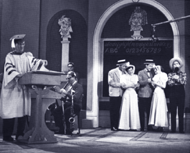 Kay Kyser's Kollege of Musical Knowledge Kay Kyser's Kollege of Musical Knowledge
Before there was 'Jeopardy' (1964-present) and 'Name That Tune' (1953-77), there was this wild NBC show (sponsored by Chrysler) that ran from December 1949 - December 1950 that combined similar elements of both. Popular bandleader Kay Kyser, clad in cap and gown and calling himself 'The Old Perfesser', presided over the madness each week. On hand was a full band along with singers Ish Kabbible (who had several hits as a vocalist for Kyser's band in the Forties) and Mike Douglas (who went on to host his own daytime show two decades later). In the game, contestants listen to a selection played by Kyser's band and then answer a true/false question incorrectly to win - then Kyser would yell: "That's right, you're wrong!". If the contestants were stumped, the audience (student body) yelled the correct answer in unison. Players would progress from "mid-terms" to the "final exam" to get the big money payoff at the end of the show. The series was very popular, but ended when Kyser quit show business, and sponsor conflicts kept the show from simply being re-cast. 'The Kollege of Musical Knowledge' was eventually revived for a short time in 1954 with host Tennessee Ernie Ford and a compliment of cheerleaders, but the new format failed.
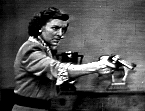 Armchair Detective Armchair Detective
A duo of fifteen-minute 'mysteries' are presented by host H. Allen Smith, then two studio contestants (and viewers at home) are asked to guess the answer to the riddle when the action stops, based on clues given throughout the stories. This low-budget series ran on CBS in the summer of 1949.
If you believe this scene, working in an office in the Forties must have been quite exciting, with everybody packing heat.
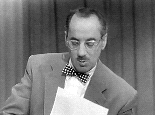
 You Bet Your Life You Bet Your Life
'You Bet Your Life' was broadcast on radio beginning in 1947, initially moving to television in 1950 as the radio show with cameras. On the program, contestants had the potential to win $10,000, $5,000, or $2,000 in a bonus round at the end of the show.
One famous feature of every episode was the 'duck' that would come down from the ceiling at the beginning to reveal the secret word. Groucho would greet each contestant with the phrase, "Say the secret word and win a hundred dollars".
One exchange from 1955, unearthed by film archivist Jeff Vilencia, is considered the most famous moment of the show. Legend has it that a woman on the show described how she gave birth to 17 children. One of the daughters explained: "My Daddy loves children", to which Groucho replied, "I like cigars, but I take them out of my mouth every once in a while!" In a TVparty exclusive, here is what actually aired.
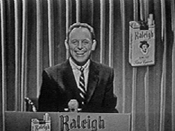 Penny To A Million Penny To A Million
Here's an obscure one that ran only five months, from May - September 1955. This ABC game show, hosted by Bill Goodwin, starts four contestants (chosen from the studio audience) out with only one penny, and then doubles their winnings for each right answer. In that way, it's played similar to today's "Who Wants To Be A Millionaire", except the "million" here is one million pennies (that's $10,000).
Like so many TV shows of the Fifties, the sponsor was a cigarette company (the networks lost millions when TV cigarette ads were banned in 1972). Don't blame me if you start smoking after watching these clips!
Queen For A Day
The audience's sympathy applause decided the winner, who was then crowned, robed, tiara-ed, throned, and showered with gifts like refrigerators and washing machines. Jeanne Cagney (sister of James Cagney) hosted a fashion segment that ran between the many tales of woe. The show was broadcast form the glamourous Moulin Rouge restaurant on the corner of Hollywood and Vine in Hollywood. This very popular daytime entry started on radio in 1945, moved to TV in 1956 and finished its run on television in 1964 (with a brief revival in 1969). The show was so popular in its heyday, with so many people lined up outside the studio for tapings, that 'Queen For A Day' was expanded to 45 minutes to accommodate a fifth contestant. I don't know if it's progress, but today people go on daytime talk shows and tell their sad stories and all they get is a trip to Chicago and a lifetime of humiliation.
 Homerun Derby Homerun Derby
When Mark McGwire and Sammy Sosa were racing to make 62 homeruns in 1998, the press called it a "Homerun Derby" - no doubt referring to the popular syndicated television series from 1959-61.
Big name batters like Hank Aaron, Duke Snider, Mickey Mantle, Willie Mays, Wally Post and Dick Stuart were featured on the series. It was especially interesting to watch the banter in the box - not all of the players seemed comfortable with the idea that they needed to bat four or five homeruns in a row to avoid looking bad!
|





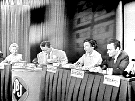 Originally
broadcast for TV on Los Angeles local KNXT, the show went national in
1953 on the ABC network, but lasted only a single network season. No
wonder - it was little more than a radio show brought to life, with
wall-to-wall commercial endorsements and movie plugs (that are still
common on radio).
Originally
broadcast for TV on Los Angeles local KNXT, the show went national in
1953 on the ABC network, but lasted only a single network season. No
wonder - it was little more than a radio show brought to life, with
wall-to-wall commercial endorsements and movie plugs (that are still
common on radio).
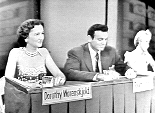 On
'Jukebox Jury', six young, glamorous late-Forties' B-movie stars and
minor recording artists were on-hand to judge the latest record company
releases. Celebrities like Barry Sullivan, Maureen O'Sullivan, Phyllis
Winger, and Jane Powell form a six pack of stars who line up on either
side of the host. Their job: to sit still and look cool while the three-minute
single played and the TV camera probed them - then offer an opinion
of the record.
On
'Jukebox Jury', six young, glamorous late-Forties' B-movie stars and
minor recording artists were on-hand to judge the latest record company
releases. Celebrities like Barry Sullivan, Maureen O'Sullivan, Phyllis
Winger, and Jane Powell form a six pack of stars who line up on either
side of the host. Their job: to sit still and look cool while the three-minute
single played and the TV camera probed them - then offer an opinion
of the record.
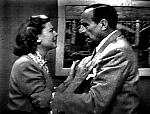 Check
out the idiotic plot twist
Check
out the idiotic plot twist 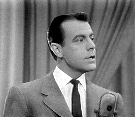 People
tuned in to You Bet Your Life to watch legendary movie comedian
Groucho Marx grill the contestants, the game itself was almost inconsequential.
George Finneman played the straight man and kept the game on track.
People
tuned in to You Bet Your Life to watch legendary movie comedian
Groucho Marx grill the contestants, the game itself was almost inconsequential.
George Finneman played the straight man and kept the game on track.
 Groucho's
quick wit made for some of the funniest moments in television history,
with much of the humor coming from the
Groucho's
quick wit made for some of the funniest moments in television history,
with much of the humor coming from the 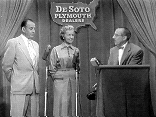 'You Bet
Your Life' was almost canceled before it began. The show's original
sponsor (DeSoto Automobiles) assumed when they signed Groucho that he
would do the series in his familiar black frock coat and painted-on
mustache from his movie roles. When Groucho refused, the sponsors tried
to pull the plug, but discovered that there was no clause in the comedian's
contract requiring him to wear a frock coat. "If I can't be funny on
television without funny clothes and makeup, to hell with it." was Groucho's
attitude. The program ran for 11 years.
'You Bet
Your Life' was almost canceled before it began. The show's original
sponsor (DeSoto Automobiles) assumed when they signed Groucho that he
would do the series in his familiar black frock coat and painted-on
mustache from his movie roles. When Groucho refused, the sponsors tried
to pull the plug, but discovered that there was no clause in the comedian's
contract requiring him to wear a frock coat. "If I can't be funny on
television without funny clothes and makeup, to hell with it." was Groucho's
attitude. The program ran for 11 years.
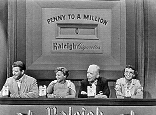 One problem with
the 'Penny To A Million' concept: you could answer ten questions correctly
and still only have $256.00. Still, $10,000 was a LOT of money back
then.
One problem with
the 'Penny To A Million' concept: you could answer ten questions correctly
and still only have $256.00. Still, $10,000 was a LOT of money back
then.
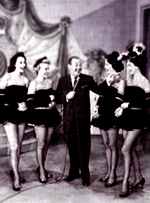 Jack Bailey hosted four contestants
chosen from the studio audience that compete for prizes by telling their
sad life stories - and people back then had it a LOT rougher than we
do today! Heck, just going through a GOOD day in the Fifties would be
like a major hardship today...
Jack Bailey hosted four contestants
chosen from the studio audience that compete for prizes by telling their
sad life stories - and people back then had it a LOT rougher than we
do today! Heck, just going through a GOOD day in the Fifties would be
like a major hardship today...
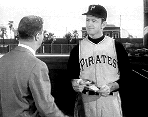 Hosted
by Mark Scott, this unusual game show pitted major League hitters against
one another for cash. Bat three homeruns in a row, and it's worth $500,
another $500 for the fourth in a row and $1,000 apiece after that. And
the players got to keep the cash, no giving it away to charity like
they do today!
Hosted
by Mark Scott, this unusual game show pitted major League hitters against
one another for cash. Bat three homeruns in a row, and it's worth $500,
another $500 for the fourth in a row and $1,000 apiece after that. And
the players got to keep the cash, no giving it away to charity like
they do today!
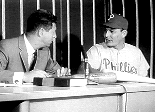 This
only added to the tension, and made
for a genuinely exciting game show - with no lights, whistles or dramatic
music.
This
only added to the tension, and made
for a genuinely exciting game show - with no lights, whistles or dramatic
music.