



TV Shows on DVD/ / / / / TV Blog/ / / / / Punk Book/ / / Holiday
Specials on DVD / /
Classic
Commercials
|
|
|
|
|
|
|
| |
||||||
TV Shows on DVD/ / / / / TV Blog/ / / / / Punk Book/ / / Holiday
Specials on DVD / /
Classic
Commercials
|
||||||
|
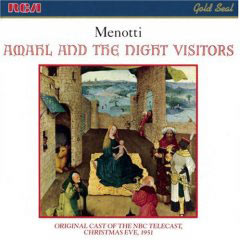
The date was December 24, 1951. The occasion was the world premiere of the first opera ever written expressly for television. That opera, Amahl and the Night Visitors, had just become a part of television history, and would become one of the most beloved Christmas specials of its time. ***** Viewed from today’s perspective, the marriage of classical music and television would seem to be an unlikely one. And yet, in the early days of TV, it was a natural match. The new medium needed inexpensive, reliable programming. It needed the prestige and credibility that well-done presentations could provide. Perhaps even more important, it needed the viewers – especially upscale viewers that would attract the attention of advertisers needed to sponsor these programs. Of all the networks in those early days, the one most closely identified with classical music programming was NBC. NBC’s commitment to it dated back to its pre-television days; its founder, David Sarnoff, had hired the famed conductor Arturo Toscanini to create and head up the radio network’s own symphony orchestra in 1937. Sarnoff believed that NBC had an obligation to serve the public interest and meet its needs, and one way to do that was through classical music programming.
This commitment continued with the development of the new medium of television. The February 16, 1953 edition of Time tells a story of NBC’s head of music programming Samuel Chotzinoff and director Peter Adler, accompanied by a small group of singers, cornering Sarnoff in the late 40s and presenting a three minute excerpt from La Bohème right there in the hallway. Sarnoff, supposedly moved to tears, asked, “Could that be done on television?” NBC’s interest in classical music wasn’t entirely altruistic, of course. For one thing, the FCC was said to be keeping a close eye on the broadcast content of the young medium, to make sure it reached its true educational potential. There were more practical, commercial considerations involved as well – such as selling television sets, for example, which was particularly important to NBC’s parent company, RCA. Few men understood this better than NBC’s head of programming, Pat Weaver. (Weaver’s daughter Sigourney wound up being pretty successful herself, but that’s another story.) Weaver envisioned what he called “spectaculars,” a sort of “must-see TV” of the 50s. These live specials would be advertised to the hilt and designed to generate so much buzz that they would encourage people to purchase new sets in order to see them. (Of course, this strategy still exists today – check your local big box electronics store around Super Bowl time.) You can bet RCA loved this part of Weaver’s plan. There was another benefit to cultural programming, one having to do with viewer demographics. It was a time when barely one in three households had a television, a time when local stations often aired programs from two, or even three, different networks – anything to fill a gap in programming. Those who were likely to watch such “prestige” programs, according to Weaver, would be upscale, more likely to have disposable income, less likely to be regular TV viewers. Sponsor such programming, Weaver argued to advertisers, and you’ll have access to an audience you wouldn’t otherwise reach. An audience with money, ready to spend it. Whatever the reasons, opera was on its way to television, and NBC Television Opera Theater made its debut in 1949 with a series of performances, including a broadcast of The Old Maid and the Thief, written by one of opera’s hottest young classical composers, Gian Carlo Menotti. An Opera for Television
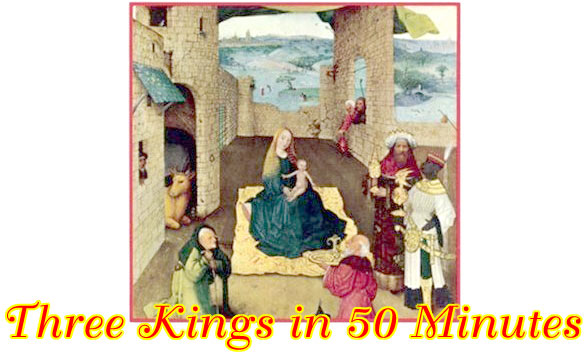
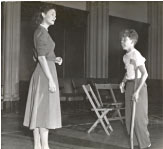
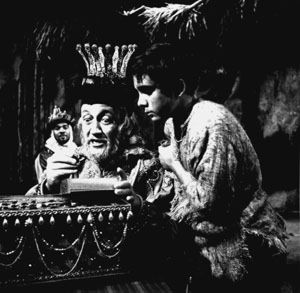
The history between NBC and Gian Carlo Menotti went a long way back. The Old Maid and the Thief had been a commission from NBC radio, premiering on April 22, 1939 as the first opera ever written for radio. (Menotti procrastinated with the composition, finishing it less than a month before the broadcast – a foreshadowing of difficulties to come.) The opera was a landmark success, and from there Menotti had gone on to even greater fame. The Medium (1949) was a smash; The Consul (1950) won the Pulitzer Prize. His picture was on the cover of Time. Menotti was the man. And so it was not surprising that in 1950 he received another commission from NBC, this time to write a Christmas opera for television. The opera would be brief, short enough to fit in a one-hour timeslot, and would be written – as were nearly all of Menotti’s operas – in English. However, much to the consternation of the network, Menotti’s penchant for procrastination once again appeared. (A November 8, 1951 article in The New York Times, headlined “Menotti Writing an Opera for TV,” said that NBC hoped to have the world premiere “around Christmas.” The article neglected to mention that Menotti had already been working on the commission for over a year.) As the deadline drew nearer, Menotti continued to struggle, at one point even offering to give back to NBC the money it had paid him. He was, he said later, without “one idea in my head.” Finally, in November of 1951, as he walked through the Metropolitan Museum of Art in New York, he saw Hieronymus Bosch’s famous painting “The Adoration of the Kings.” “[S]uddenly I heard again…the weird song of the Three Kings.” It was then, he said, that the idea came to him, as he was flooded with memories of his childhood in Italy where it was the Three Kings, and not Santa Claus, who brought presents to children at Christmastime. There was another detail of his childhood that he did not mention at the time – that as a young boy he had been a cripple, suffering from a lame leg until he was taken to a statue of a Madonna at a nearby church, whereupon his leg was healed. With this, the story – now titled Amahl and the Night Visitors – began to take shape. Rosemary Kuhlmann, who had appeared in Menotti’s The Consul, was cast in the role of Amahl’s mother. (As was typical of many characters in Menotti operas, who were often identified only by their jobs or titles, the role was simply referred to as “Amahl’s Mother.”) Andrew McKinley, David Aitken and Leon Lisher were cast as the Three Kings, Kaspar, Melchior, and Balthazar. (Menotti would later joke that his brother had always believed one of the kings was deaf since he never got all the presents he’d asked for; charmingly, Menotti portrayed Kaspar as being hard of hearing.) Frances Monachino was cast as the Page to the kings.
In the title role of Amahl, Menotti selected 12-year-old Chet Allen, a boy soprano with the famed Columbus Boychoir (now known as the American Boychoir) of Princeton, New Jersey. Thomas Schippers, who had conducted a long run of The Consul on Broadway (yes, Menotti’s operas played in the “legitimate theater”) was chosen to conduct. Kirk Browning, who had directed several NBC opera productions, would helm Amahl as well.
Menotti now had his cast. Maddingly, however, the cast still did not have the complete score. They spent the month of December rehearsing in a makeshift studio, with Menotti going over the stage directions and Browning the camera angles. Kuhlmann recalled that the cast continued to hope that the opera would be complete by Christmas Eve, the date set by NBC for the broadcast. Menotti’s companion, the noted composer Samuel Barber, was even brought in to help complete the orchestration. One apocryphal story had Menotti sequestered in a room by NBC executives, not to be let out until he finished the score. Finish it he did, though, just days before the broadcast. The upcoming event was already creating a buzz. Back in October, Opera News had described the nation as having “Menotti Mania,” with over 350 performances of various Menotti operas being staged throughout the country. The legendary conductor Toscanini had attended many of the rehearsals for Amahl (moved to tears, according to several accounts) and there were pre-broadcast stories in The New York Times, Time and other publications. Hallmark had signed on to sponsor the broadcast as the inaugural presentation of what would come to be known as the Hallmark Hall of Fame, making it the first televised opera ever to be sponsored. NBC had lined up 35 affiliates throughout the East, South and Midwest, the largest ever network hookup for an opera broadcast. (Their ambitious original plan, which fell through, had envisioned a coast-to-coast lineup of stations.) It was safe to say, therefore, that Amahl carried with it high expectations. Christmas specials were prominent on each of the four networks that Christmas Eve. At 9:00 DuMont aired The Smallest Gift, an hour-long made-for-TV drama. ABC countered with the movie Hansel and Gretel, starting directly opposite Amahl at 9:30. CBS’s “Studio One,” beginning at 10:00, featured The Story of Sara Crewe, an adaptation of The Little Princess especially for Christmas. While each of these shows overlapped with Amahl, NBC – thanks to its substantial investment in station ownership nationwide – had the advantage. And so at 9:30 on December 24, 1951, in Studio 8-H of Radio City Music Hall, the first opera ever written expressly for television went live on the air.
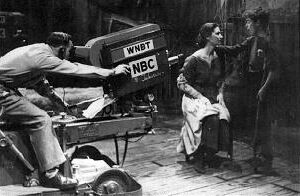
The scene was a dramatic one – and, par for the course for early television, far from ideal. For one thing, although 8-H was the largest television studio in America, it wasn’t nearly large enough for the cast, crew, and musicians. The result, among other things, was that singers and orchestra would have no direct contact with each other. The orchestra would be arranged in a separate part of the studio; Schippers would see the action on the set via closed-circuit hookup, while the singers would hear the music piped in through speakers. Up in the control room would be Browning. At his disposal were four cameras – three inside the “hut” where Amahl and his mother lived, and one outside – and three boom microphones, one between each camera. His “control” was far from absolute, however; union rules of the era prevented the director from speaking directly to the cameramen, requiring him to go through the technical director to communicate his instructions. Such an arrangement was a recipe for disaster, especially for a live broadcast. Menotti was no stranger to the challenges of television, though, and he and Browning worked closely on the camera script, ensuring that there would be no spare gesture, no extraneous movement that would throw an actor out of frame. The
cumbersome equipment of the time would also prove to be a challenge, as
Browning recalled in a 1994 interview. “As I remember, I had a pedestal
camera which weighed four to five hundred pounds and the carriage that
carried it weighed another seven to eight hundred pounds. It was an enormous
piece of equipment. And the cables – there were three cables bound
together, and you had to have two people, if you were moving the camera,
just to move the cable.” Movement was limited, however, for “once
you got over a 90mm lens, you couldn’t move the camera because the
movement registered on the camera and you would lose focus almost immediately.”
When the camera light winked on at 9:30, viewers saw a blurred image of church bells, followed by a title card announcing that the following program was presented by Hallmark. It is often stated that the actress Sarah Churchill hosted that first broadcast, since she subsequently served as host of Hall of Fame for the first couple of years, but in fact it was Nelson Case, host of NBC’s Armstrong Circle Theater, who greeted the audience. (Amahl was, in fact, being presented in Armstrong’s regular Tuesday night time slot.) After a solemn, if overlong, introduction, Case presented Menotti, who stood on a set in front of a fake fireplace decorated with garland, the Bosch painting hanging over the mantle. Speaking from notes and in Italian-accented English, Menotti said he hoped that parents had allowed their children to stay up late for the broadcast, since the opera had been written for them and “I don’t want you to be like those awful parents who insist on playing with their children’s toys.” He then introduced the people who had helped make Amahl possible, asking them to join him on camera since the audience “won’t see [them] while the opera goes on”: Browning, who “photographed this opera the way I saw it in the windows of my imagination,” Schippers, who “captured the sounds of my childhood,” and set designer Eugene Berman, “who designed the sets that come straight out of my own heart.” Menotti shared long-ago childhood memories – how, as a boy, he had never actually seen the Three Kings but remembered “hearing the camel’s hoofs” as they approached, how when he had come to America he had soon forgotten about the three “dear old kings” because of the plethora of Santa Clauses and other American Christmas traditions, and how he had “gotten myself in trouble” with the opera until he had been reminded of the kings by Bosch’s painting. “I suddenly realized they had come back to me and brought me a gift,” he said, concluding, “I now hand this gift to you.” As a series of handwritten slides (taking a moment to come into focus) introduced the cast and crew, the overture began in the background – a tender, moving melody that soon gave way to the sound of a pipe. The camera dissolved to a star high in the sky, and then slowly panned down to a young boy playing the pipe. Amahl and the Night Visitors had begun.
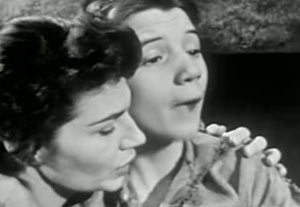
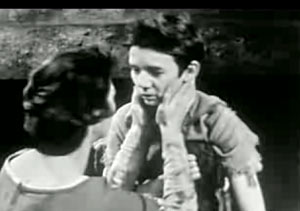
The opera tells the story of Amahl, a lame shepherd boy, and his widowed mother. His mother loves Amahl dearly but at the same time is frustrated by his constant dreaming, and worried about how to make ends meet and survive in the community of shepherds in which they live. These pressures combine to make her seem sterner than she actually is. She fears that they soon will have to become beggars, but Amahl – a happy boy despite his handicap – reassures her that he will be able to help, that someday people will give them gold and everything will be all right. On this night she has to encourage Amahl several times to come in from outside, for it is late and the night is dark. Amahl is reluctant to go inside, for he is captivated by the bright star with the flaming tail he sees shining in the night sky. Eventually, however, he does come in. Soon after, there is a knock at the door, and there appear three kings, Kaspar, Melchior, and Balthazar, and their page, loaded down with crates, looking for a place in which they can rest for a few hours. (Here it is worth noting that the broadcast features a fascinating attempt at a primitive “special effect.” Menotti wanted the approach of the Kings to suggest a journey of a great distance. The entrance of the Kings began, therefore, with only their voices being heard. While Amahl and his mother lie sleeping, the camera zoomed in on a close up of Rosemary Kuhlmann. Then, using her back as a movie screen, a prerecorded film of the Kings’ entry was projected. Browning then cut to a shot of Kuhlmann from a different angle, while the lyrics “the shepherd dreams inside the fold” were sung – suggesting, subtly, that the Kings might be nothing more than a dream. It was a complex effect, sophisticated for the time, especially for live television. It’s not known how many times this effect was used in subsequent broadcasts of Amahl; by 1955 it had been replaced by a simple cut from the inside of the hut to the outdoor set.) Wanting to entertain their distinguished visitors, the mother goes to get wood for a fire, leaving Amahl alone with the visitors. The curious boy can’t resist peppering the kings with questions; they respond with a gentle but dignified amusement. When mother returns, she notices the precious cargo which the kings have brought with them – crates containing gold, frankincense and myrrh. The kings explain that they have been following the star overhead, looking for a Child. In a quartet that is perhaps the most famous piece from the opera, the kings ask her if she has seen such a child. Yes, she replies bitterly, thinking of Amahl, I know a child, one who has nothing and could benefit from the riches of the kings. Other shepherds arrive, bearing gifts for the distinguished visitors, and dancing while Amahl plays his pipe. But the hour is late, and the kings beg off further demonstrations of hospitality, seeking a few moments of rest. As they sleep, the mother looks longingly at the gold, realizing that even a small portion of it would be the answer to their prayers. Overcome by desperation, she reaches for the gold, in the process waking the Page, who grabs her and calls out to the kings. Amahl attempts to defend his mother, flailing away at the servant, and begging the kings to forgive her. Melchior tells her to keep the gold, as the Child “doesn't need our gold. On love, on love alone He will build His Kingdom.” However, she refuses, realizing that this Child must be special indeed (“For such a King I waited all my life”), and she wishes she had a gift of her own she could send along. Amahl offers his only possession, the crutch that he made himself. As he does so, he finds that he can walk; his leg has been healed. The kings proclaim this a sign from the Child, in response to the love that this humble family has shown. The joyous Amahl asks if he might be allowed to accompany the kings and present his crutch personally; the kings join in this request. In response to her questions, Amahl assures his mother that he really wants to go, and she relents. The kings promise that he will return “on a camel’s back” and they depart, the opening theme returning as in the distance the shepherds herald the morning of the new day. After a few final comments by Nelson Case, the broadcast ended with a selection of Christmas carols performed by the Columbus Boychoir. The Birth of a Tradition The reception to the broadcast was, in a word, overwhelming. It began the next morning, Christmas Day, with an unprecedented front-page review in The New York Times, written not by the paper’s TV critic Jack Gould, but by its theater and music critic, the famed Olin Downes. Headlined “Menotti Opera, the First for TV, Has Its Premiere; Boy, 12, Is Star,” Downes raved about the broadcast, calling it an “historic event in the rapidly evolving art of television.” Menotti, Downes wrote, had “produced a work that few indeed could have seen and heard last night save through blurred eyes and with emotions that were not easy to conceal.” He was equally effusive in his praise of Chet Allen, citing his “remarkable acting and facial expression.” Rosemary Kuhlmann’s was a “moving portrayal . . .a highly intelligent and authoritative impersonation” and Thomas Schippers’ conducting was “of the first order.” Variety, in an unusually straightforward review, called the production “a work of art wrought for TV and reduced to the exacting intimacies of TV [that] automatically lifted the medium into a new cultural sphere of importance.” It predicted that the opera “could well become standard TV fare in the repertoire of Christmas musical-operatic offerings. Certainly it is inconceivable that it would be allowed to pass into the TV limbo of a one-shot performance.” Time, in an article entitled “Three Kings in 50 Minutes,” called it “a production of care and quality.” Downes early on spotted the power present in the “mechanical devises of video, a throbbing personal communication.” And indeed, Browning’s direction of Amahl was brilliant and creative, using closeups of Allen and Kuhlmann to suggest a distance between them when in fact they were standing only a few feet apart, and letting the camera show the approach of the kings as it would have been seen through the boy’s eyes – an angle that would never have been available to a live audience in an opera hall. Television was able to present opera in a unique and distinctive way, giving some their first taste of opera, allowing others to view it in a way never before seen. The atmosphere on the set was magical as well. The small cast, having spent nearly a month in less than ideal conditions, had in fact come to resemble a family with the studio their home, and in years to come critics would remark on the noticeable chemistry that existed during the annual broadcasts. David Aiken remembered standing off stage with the other kings, preparing for their initial entrance. “Listen to Rosemary,” he whispered to them in awe. “Her voice is soaring and beautiful.” By the end, everyone knew they’d nailed it.
It
was estimated that five million people saw the live broadcast, the largest
audience ever to see a televised opera. And there was no doubt they’d
liked what they’d seen; enthusiastic viewers jamming the NBC switchboard
for hours following the broadcast. By December 26 the network was already
discussing an encore presentation, and indeed Amahl would appear once
again, broadcast live with the original cast on Easter Sunday 1952, the
only time that it would ever be shown on TV outside of the Christmas season.
It won a Peabody Award later in 1952, and when the Times TV critic, Jack
Gould, did finally write about it, it was to cite it as one of the finest
accomplishments in the short (six years!) history of television. The Gift That Kept On Giving In
early January 1952 the cast reunited, under the supervision of Menotti,
to record an album of the opera. Considered the definitive version, it
remains a best seller to this day. Soon Amahl would move out of the television studio and into the theater. Rosemary Kuhlmann and Chet Allen would reprise their roles in April 1952 with the New York City Opera, conducted by Thomas Schippers. Because Menotti had written the parts so that they could be performed by capable amateur companies, Amahl became a popular Yuletide production throughout the country, and today is thought to be the most frequently performed opera ever written – at least 500 times each Christmas season, according to the publisher, G. Schirmer. Amahl became firmly entrenched as an annual part of NBC’s Christmas programming, and would stay there for sixteen years (in 1958 Time observed that the opera had been a “yearly joy since 1951 and may well be one in 2051”). Of the 43 operas that the NBC Opera Company would produce in its fifteen years, Amahl was the only one to receive consistent commercial sponsorship, with companies often competing to sponsor the annual broadcast – not, as author Jennifer Barnes notes, as “a charitable or benevolent gesture, but because Amahl commanded such large audiences. Few times in television history has business associated a particular opera with the propensity to make, rather than lose, money.” Contrary to what is popularly believed today, Amahl wasn’t always broadcast on Christmas Eve or Christmas Day; while it is true that it was shown nine times on those dates, it was also broadcast as early as December 12 (in 1965, when it was hosted by Kukla, Fran & Ollie), and most frequently was scheduled on the Sunday afternoon before Christmas. Beginning with the 1952 Christmas Day broadcast, Bill McIver took over the role of Amahl, and would play it for four years, longer than anyone else. (Unlike the rest of the cast, the shelf life for a boy soprano was rather short.) The 1953 broadcast was a landmark of another kind, the first program to broadcast in color. For
Rosemary Kuhlmann and the adult members of the original cast (Andrew McKinley,
David Aiken, Leon Lischer and Francis Monachino), Amahl became more than
just an annual broadcast. They would tour the country each year (the role
of Amahl would usually be taken by a local boy), performing with symphony
orchestras throughout the Midwest, offering as many as 50 performances
of the opera to schools, churches, and other groups. Kuhlmann recalls
that, because of the brief length of the opera, they would sometimes do
three performances in a row, as school kids were shuttled in and out of
the auditorium. The effect on these children, she recalls, was as magical
as it had been to the television audience that first night. The five would
continue in the annual NBC production year after year, until it was completely
redone in 1963. Kuhlmann herself would perform Amahl on stage
for the last time in 1981. The Columbus Boychoir, which today is known as the American Boychoir, was already famous at the time of Amahl and became a familiar feature on television for years. Both Chet Allen and his understudy for the premiere, Richard Mincer, were Columbus Boychoir members, and Menotti is said to have written Amahl with the Columbus Boychoir sound in mind. Traditionally the Boychoir would appear at the end of the telecast, filling out the remainder of the hour timeslot with a performance of carols. The American Boychoir (americanboychoir.org). celebrating its 70th anniversary, continues to train world-recognized performers.
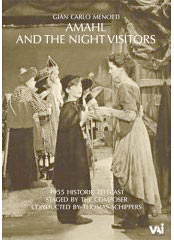
Chet Allen played Amahl for the first two broadcasts, the premiere in 1951 and the reprise at Easter 1952. Later he would appear in movies, including Meet Me at the Fair with Dan Dailey, and the short-lived TV series Bonino with Ezio Pinza, but none approached the visibility or impact of Amahl, and he faded from the scene after his voice changed. He died in 1984, remembered as the boy singer who had charmed a nation in the role of a lifetime. Gian Carlo Menotti continued to write operas after Amahl, and to find considerable success with them, winning a second Pulitzer in 1955 for The Saint of Bleecker Street. But the classical music world can be a fickle one, and by the 1960s Menotti had fallen out of favor, his graceful music rejected by a musical generation intent on modernism and dissonance. He remained a prolific composer until his death in February 2007, founding the famed Spoleto festivals in Italy and South Carolina, but never again reached the critical heights he had visited in the 50s. Amahl remains his most famous, and most popular, composition. ***** At 6:30 p.m. on December 25, 1966, Amahl and the Night Visitors was broadcast on NBC for the sixteenth and last time as an annual Christmas event. Its end was due not to low ratings as one might today think, but instead because of a dispute between the network and Menotti. NBC had mounted a completely new production of Amahl in 1963, with an all-new cast, set and staging, and, rather than doing a new telecast each year, had shown this tape in subsequent airings. Simply put, Menotti hated it. It was the first to take place without his direct supervision or approval, and the result, according to Menotti, was “terrible.” He couldn’t do anything about it contractually at the time since NBC owned the television rights, but in 1966 those rights reverted back to him, and he struck quickly, announcing in September that he would no longer give NBC permission to continue showing the existing tape. “I would rather see no production at all of ‘Amahl’ than a bad one,” Menotti told reporters. The network, having spent around $500,000 to tape the current production, declined his demand that a new production be done, and pointed out that the ratings had actually increased over the years since the new production had debuted. Menotti finally relented in November and allowed the broadcast as scheduled, but his relationship with NBC had been damaged beyond repair, and that 1966 telecast would be Amahl’s last regular appearance. A remake shown on Christmas Eve in 1978, starring Teresa Stratas and filmed partially in the Holy Land, was neither a critical nor commercial success, and NBC aired it only once. And thus television’s first Christmas tradition came to an end. So today Amahl lives on as a memory, a part of television’s dusty past. It remains the most frequently performed opera in history, being staged at Christmastime throughout the world by countless amateur and professional opera companies alike. The original 1951 broadcast, long thought to be lost, reappeared in 2001 as a special presentation of the Museum of Television & Radio, and the 1955 production with Bill McIver as Amahl is available on DVD.
Mitchell
Hadley is Managing Editor and “Cultural Archaeologist” of
“Our Word and Welcome to It,” at hadleyblog.blogspot.com. |

Christmas Specials
Amahl & The Night Visitors
Click here to see an excerpt from the 1955 broadcast featuring Bill McIver as Amahl Click here to listen to an NPR interview with Menotti on the 50th anniversary of the first telecast Order the 1955 telecast of Amahl & The Night Visitors on DVD
|


|
 |
 |
 |
 |
 |
 |
 |
| TV
Shows on DVD/ / /
/ / / / TV Show Reviews /
/ / / / / / Cartoons
on DVD/ / / / / /
/ Christmas
Specials on DVD /
/ / / / / Classic
Commercials |
|||||||
|
||||||||||||||
 It
was readily apparent to all that a Christmas tradition had been created
– to NBC, the network that broadcast it; to Hallmark, the company
that sponsored it, to the millions of people who saw the live broadcast
on Christmas Eve; and to the millions more who read about it on the front
page of The New York Times the next day.
It
was readily apparent to all that a Christmas tradition had been created
– to NBC, the network that broadcast it; to Hallmark, the company
that sponsored it, to the millions of people who saw the live broadcast
on Christmas Eve; and to the millions more who read about it on the front
page of The New York Times the next day.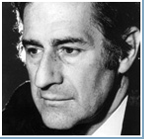
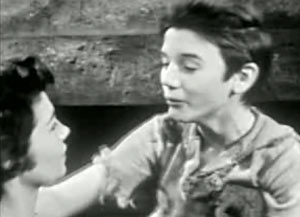 Watching
it, one can perhaps get a hint of the drama and wonder that resulted from
that historic first broadcast on Christmas Eve in 1951. For Amahl
and the Night Visitors is undeniably a part of television history,
a landmark in programming that even today reminds us of the time when
an opera for children became television’s first Christmas tradition.
Watching
it, one can perhaps get a hint of the drama and wonder that resulted from
that historic first broadcast on Christmas Eve in 1951. For Amahl
and the Night Visitors is undeniably a part of television history,
a landmark in programming that even today reminds us of the time when
an opera for children became television’s first Christmas tradition.